A new study has linked more fat around organs to faster brain aging, with glucose and insulin likely mediators.
The study, led by a team from Ben-Gurion University of the Negev (BGU) in Israel, suggests that reducing visceral fat may protect against brain damage.
Like other parts of the body, the brain doesn’t necessarily age at a uniform rate: wear and tear can increase or decrease, depending on a variety of factors. Faster brain aging typically means faster decline in mental ability and a higher risk of brain disease.
Crucially, this new study shows that brain aging may be indirectly influenced by visceral fat, in particular. At the same time, subcutaneous fat, which accumulates around most of the body—and has the greatest impact on our weight—was not found to be linked to brain health.
“Our findings show that long-term exposure to increased visceral fat is associated with both accelerated brain atrophy and poorer cognitive performance, while sustained reductions in visceral fat achieved through lifestyle changes predict preserved brain structure and cognitive performance in midlife,” the researchers write in their published paper.
The study data is based on MRI scans taken of 533 adults (mostly men) who were followed for varying periods of time, from 5 to 16 years, after completing one of four different clinical dietary trials.
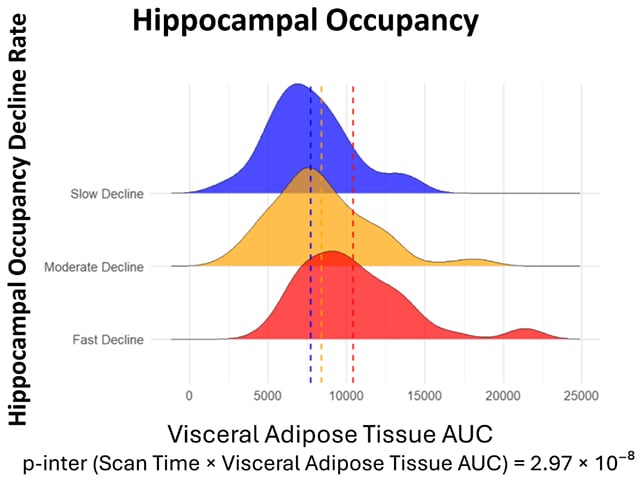
In addition to the data on visceral fat and brain volume obtained from the scans, the researchers also used cognitive assessment tests to measure the mental abilities of the study participants over time and took blood samples to measure various biomarkers.
Over the follow-up periods, lower levels of visceral fat were associated with better scores on cognitive tests, higher brain volume and gray matter volume, and better scores on the Hippocampal Occupancy Score – a measure specifically designed to assess brain atrophy.
The researchers also found that more visceral fat was associated with faster expansion of the cerebral hemispheres, a sign of brain aging. Subcutaneous fat, however, showed none of these associations.
Why might this link exist? The blood tests found that elevated blood sugar levels were associated with brain atrophy over time, suggesting that blood sugar imbalances played a role in the damage. Visceral fat has previously been linked to insulin resistance and dementia.
There’s good news: the participants who lost the most visceral fat in the original diet studies had the best preserved brain volume later in life. Add in the link to blood sugar, and it seems that good old-fashioned diet and exercise can help your head as much as your stomach.
“The results suggest that blood sugar control and reduction of visceral fat in the abdomen are measurable, modifiable, and realistic goals in midlife—with real potential to slow brain degeneration and reduce the risk of cognitive decline,” says epidemiologist Iris Shai of BGU.
While the study doesn’t prove that reducing visceral fat can slow brain aging, it does provide a strong case for it. Another thing to keep in mind is that the study participants were mostly male and mostly overweight—so more research needs to be done to see how widespread this is.
Given everything we already know about brain aging and visceral fat, this is yet another reason to think about eating healthily and being active. The researchers also want to see greater awareness of how specifically targeting visceral fat, rather than simply measuring weight loss, can lead to health benefits.



0 Comments