
Scientists have been searching for decades for quantum spin liquids (QSLs) – materials that are believed to have some special properties that could improve our understanding of magnetism and efforts to build quantum computers.
In a new study, a material previously thought to be a QSL turned out to be something else. The finding suggests that we need to rethink how we evaluate QSL candidates; it also reveals a new, non-quantum state of matter.
According to the international team of researchers behind the study, the material, cerium magnesium hexaluminate (CeMgAl11O19), has some unique, unseen properties that could be very useful, but it does not qualify as a QSL.
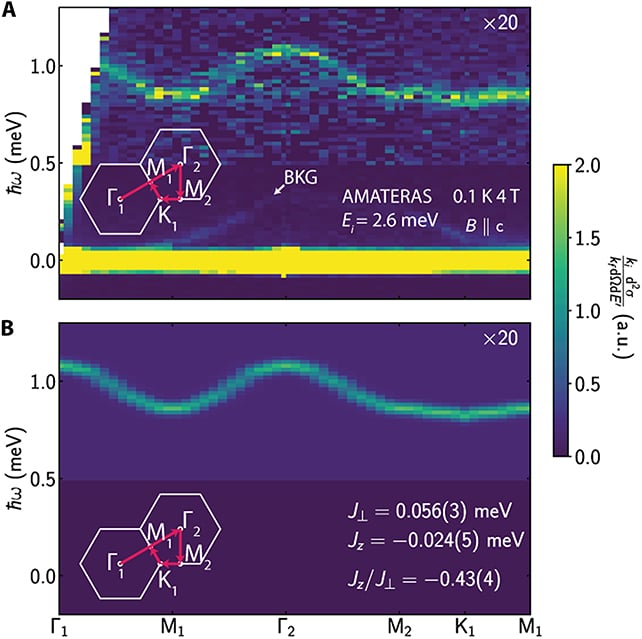
“The material is classified as a quantum spin fluid because of two properties: the observation of a continuum of states and the absence of magnetic order,” said physicist Bin Gao, of Rice University in the US.
“But a closer look at the material showed that the underlying cause of these observations was not a quantum spin liquid phase.”
Until now, scientists have searched for QSLs by cooling the materials to extremely low temperatures and by looking for two properties that CeMgAl11O19 has: an unclear continuum of states and chaotic magnetic behavior that does not follow the normal rules.
This may not seem particularly relevant to everyday life, but there are some potentially huge breakthroughs associated with QSLs, especially in the field of quantum computing.
These systems promise an exponential leap in terms of processing power, but they're still some way from becoming reality – at least in fully realized forms that are useful outside of laboratory benchmarks.
It's thought that QSLs could help improve the stability of quantum computer systems, which, in their current prototype form, are incredibly fragile and prone to errors. Potentially, QSL particles could make quantum data storage more resilient.
If these computers can be developed and optimized, then there's good reason to believe the boost in performance would benefit climate change modeling, weather forecasting, drug discoveries, and more.
It's the 'spin' in the QSL that's crucial: It refers to a certain type of momentum that a particle shows when it moves through a magnetic state. In a QSL, that momentum is notably disordered, according to current hypotheses.
Progress is definitely being made in identifying QSL candidates, though their rarity makes them challenging to track down.
While there will be some disappointment that CeMgAl11O19 isn't our first, genuine QSL, it nevertheless has a fascinating set of properties – and will serve as a useful benchmark for scientists trying to find these elusive materials.
Related: Atomic Clocks Could Reveal The Hidden Quantum Nature of Time Itself
"This is a new state of matter that, to our knowledge, we are the first to describe," says physicist Pengcheng Dai, from Rice University.
"It underscores the importance of careful observation and thorough investigation of your data."



0 Comments