
People love beer. Globally, over 187.9 million kiloliters (49.6 billion gallons) of beer are consumed annually.
However, according to new research, this popular beverage has also been added to the list of products containing PFAS (polyfluoroalkyl compounds), also known as "perpetual chemicals."
PFAS earned this nickname because they do not easily break down in the environment. It is estimated that there are about 12,000 types of perpetual chemicals, and while their health effects are largely unknown, PFOA (perfluorooctanoic acid) and PFOS (perfluorooctanesulfonic acid) are known to be associated with health issues, including an increased risk of cancer and birth defects.
Scientists at the Research Triangle Institute, a non-profit U.S. research organization, used methods employed by the U.S. Environmental Protection Agency (EPA) to determine how and at what concentrations PFAS are present in beer. "As someone who drinks beer occasionally myself, I wondered if the PFAS contained in tap water might be getting into the beer," says toxicologist Jennifer Hoponik Redman.
As a result, significant amounts of PFAS were detected. The research team measured PFAS levels exceeding the maximum permissible limits set by the EPA, and some argue that these limits are still insufficient to protect people from these chemicals.
While breweries typically have their own filtration and treatment systems, these systems are not designed to remove PFAS. Up to seven liters of water can be used to make one liter of beer, and the PFAS contaminants contained in that water are likely to remain there until the moment the beer is opened.
In 2021, the research team purchased at least five cans of each of 23 different types of beer from a liquor store in North Carolina.
At least one type of PFAS was detected in almost every can tested, with PFOS being detected in the majority. Three types of beer tested in this study (two produced in the upstream Cape Fear River basin in North Carolina and one produced in Michigan) exceeded the EPA's maximum permissible limit for PFOA concentration, and one type of beer produced in the downstream Cape Fear River basin exceeded the permissible limit for PFOS.
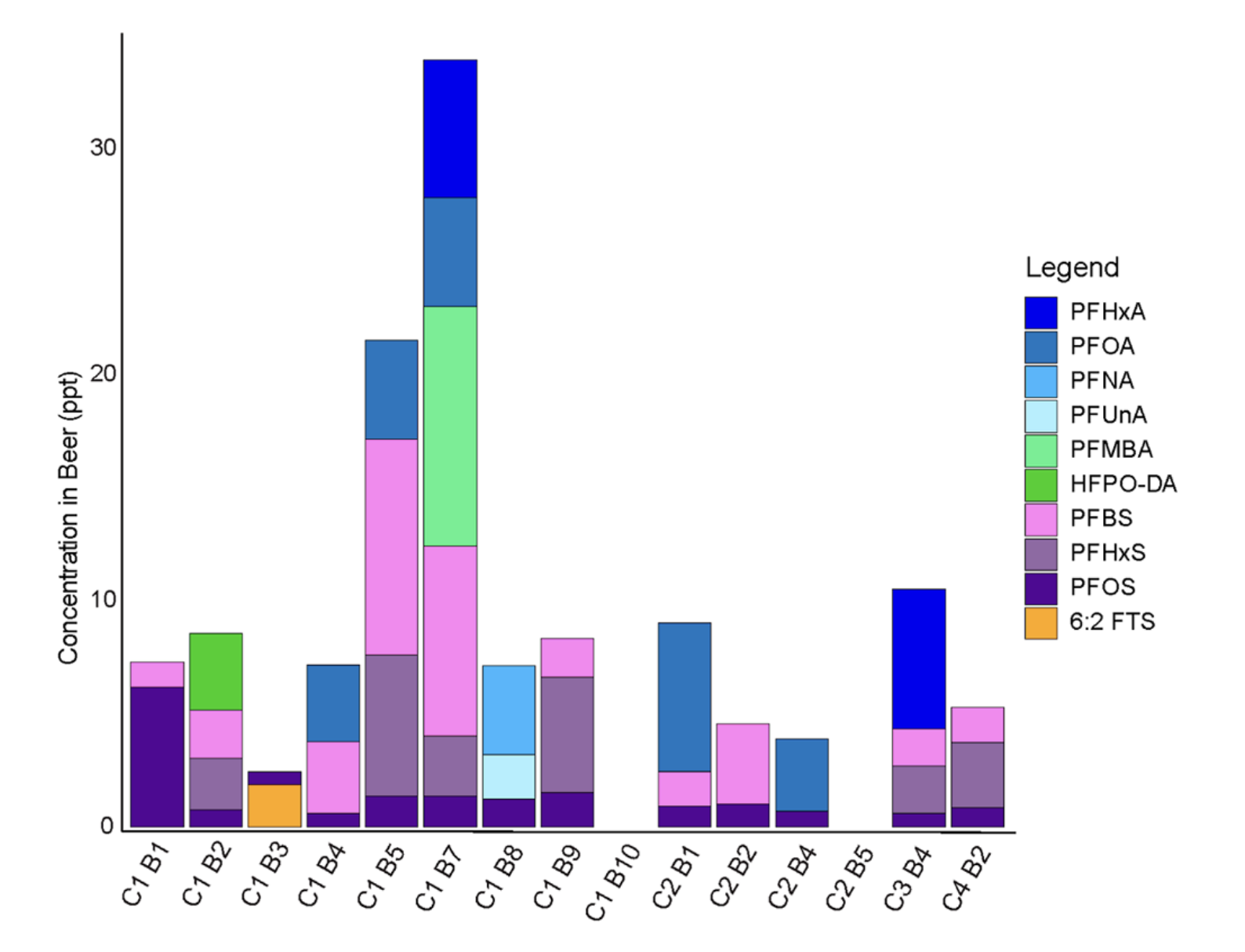
In 2023, the U.S. Environmental Protection Agency (EPA) established limits for six types of PFAS, but these were based on drinking water standards, not beer standards. However, considering there are no existing standards for the permissible amount of PFAS in beer, and that beer, like drinking water, is a ready-to-drink beverage, the research team led by Hofonic Redman believed that these drinking water standards could be applied to beer.
The team reported, "Applying EPA Method 533 to the analysis of PFAS in beer sold in U.S. retail stores, we found that the PFAS in beer correlates with the types and concentrations of PFAS in the tap water used for brewing."
"Beers produced in North Carolina, particularly in the Cape Fear River basin, contained more types of PFAS than beers from Michigan or California, reflecting the diversity of PFAS sources in North Carolina."
In particular, high levels and concentrations of PFAS were found in beers produced in North Carolina, California, and Michigan.
The likelihood of detecting PFAS in imported beers, including one from the Netherlands and two from Mexico, was low, which may suggest that these beer-producing countries are not facing the same levels of contamination seen in the United States.
The researchers concluded, "These findings demonstrate a strong link between drinking water and beer. Beers brewed in regions with high concentrations of PFAS in drinking water showed higher PFAS concentrations in the beer itself, indicating that drinking water is a primary pathway for PFAS contamination in beer."
The researchers hope that these findings will encourage breweries to explore methods to remove PFAS from the water used in beer production and highlight the importance of PFAS regulatory policies.
This study was published in Environmental Science & Technology.



0 Comments