
This glittering spaceship, Earth, and the solar system to which it belongs are not fixed in space, but are rotating slowly and majestically around the galactic center, as if dancing a galactic-scale waltz.
While it is often difficult for us to know exactly where the solar system has passed during this long journey, new clues have recently been discovered that have been frozen in Antarctic ice for tens of thousands of years.
A research team led by nuclear astrophysicist Dominic Kohl at the Helmholtz Center in Dresden-Rossendorf, Germany, discovered rare iron isotopes in Antarctica that show Earth passed through an interstellar dust cloud created by a recent supernova explosion.
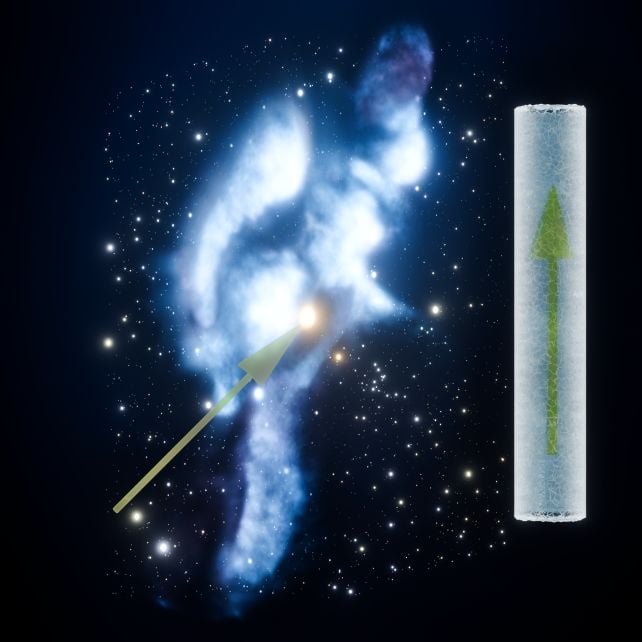
Over the past few decades, the Antarctic ice sheet has emerged as a significant resource providing valuable information about Earth's history. It began to form in layers as snow accumulated approximately 35 million years ago, with atmospheric particles trapped and frozen within each layer.
Over time, these layers, compressed by their own weight, transformed into vertical time capsules. Scientists have been able to extract long, cylindrical ice cores from these capsules to obtain a chronological record of atmospheric changes spanning millions of years.
In 2019, Koll and his colleagues analyzed fresh Antarctic snow and discovered trace amounts of the iron isotope 60Fe, or Iron-60.
More recently, they also discovered frozen Iron-60 in ice cores estimated to be between 40,000 and 81,000 years old.
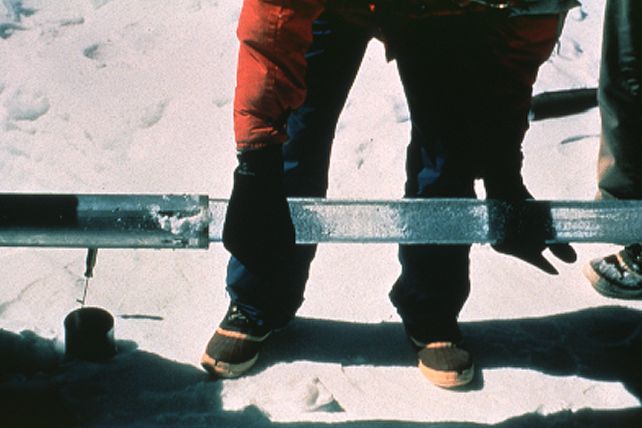
Iron-60 is a special element because it can only be produced under specific extreme conditions that do not occur naturally on Earth, such as supernova explosions.
While it is possible that some Iron-60 was introduced during the formation of the Earth, its half-life is only 2.6 million years, meaning almost all of it would have decayed within about 15 million years. The Iron-60 that existed at the time of Earth's formation 4.5 billion years ago has long since vanished.
Therefore, if Iron-60 is found on Earth above a certain threshold, it implies that it was all introduced from space. The pathways by which a significant amount of Iron-60 is naturally produced on Earth are unknown.



0 Comments