French scientists announced on Tuesday that they have set a "significant milestone" in the long journey toward nuclear fusion by successfully maintaining a superheated plasma for 22 minutes.
Nuclear fusion is a technology with the potential to provide the world with clean, safe, and nearly infinite energy, yet it has remained a challenge for the scientific community for decades.
Nuclear fusion replicates the process of two atomic nuclei fusing together that occurs at the core of stars. This is the exact opposite of the nuclear fission used in nuclear power plants.
For nuclear fusion, temperatures exceeding 100 million degrees Celsius are required to generate and maintain the plasma.
Such hot and electrically charged gas can easily become unstable, leading to energy loss and potentially hindering the efficiency of future fusion power plants.
The French Atomic Energy Commission (CEA) stated in a press release that the WEST tokamak device, located in southern France, successfully maintained a plasma state for 1,337 seconds on February 12.
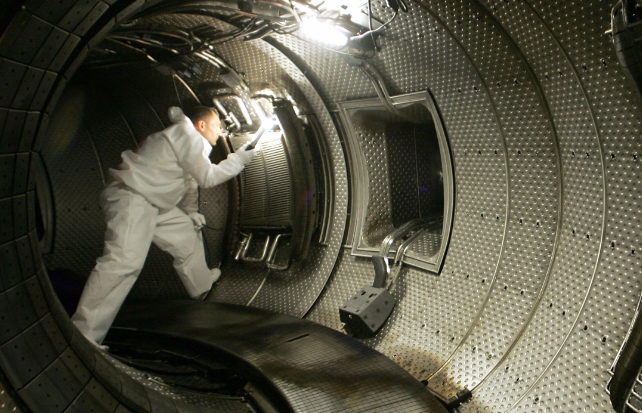
The China Atomic Energy Agency (CEA), which operates the tokamak device, announced that the results of this experiment broke the previous record set in China last month by 25%.
Anne-Isabelle Etiennebre, head of basic research at the CEA, told AFP that maintaining plasma for such an extended period "demonstrates that we can control not only plasma generation but also its maintenance."
However, she added that many "technical barriers" still need to be overcome before nuclear fusion can "produce more energy than it consumes."
According to the CEA, the WEST research team aims to extend the plasma maintenance time to "up to several hours" and raise the temperature next month.
The researchers stated that they expect to approach "conditions expected in nuclear fusion plasma" through this.
Etiennebre also said that scientists will observe the impact of such "powerful plasma" on the interior of the tokamak device.
She added that the goal is to lay the groundwork for the International Thermonuclear Experimental Reactor (ITER), which is currently under construction in France.
ITER, which first began construction in 1985, is a joint project involving China, the European Union, India, Japan, South Korea, Russia, and the United States.
Originally scheduled to begin operation this year, it has been postponed until at least 2033 due to repeated setbacks, delays, and skyrocketing costs.




0 Comments